Table of Contents
- The Mechanics of Email List Segmentation
- Data Collection Methods for Subscriber Profiling
- Segmentation Criteria: Behavioral, Demographic, and Firmographic
- Automating Personalized Workflows
- Optimizing Segments Through A/B Testing
- FAQ
The Mechanics of Email List Segmentation
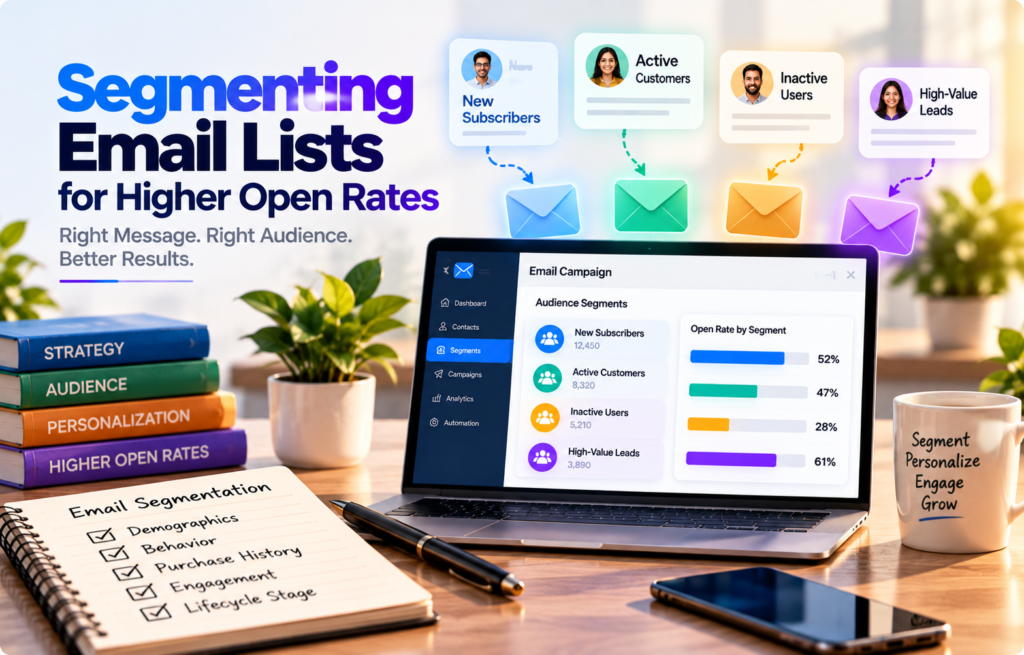
Email list segmentation divides a subscriber database into targeted groups based on shared characteristics. Instead of broadcasting a single message to an entire database, marketers use segmentation to deliver tailored messages to specific cohorts. This shift from bulk broadcasting to targeted communication forms the foundation of modern email marketing.
Why relevance drives higher open rates
The primary driver behind open rates is relevance. When a subscriber receives an email that directly addresses their current pain points, interests, or past behaviors, the perceived value of that email increases.
Consider a fitness brand. A subscriber who recently purchased running shoes is unlikely to open an email promoting weightlifting belts. However, if the brand segments its list and sends that runner a guide on marathon training recovery, the relevance spikes.
This alignment between subscriber interest and email content builds anticipation. Over time, subscribers learn that emails from a specific sender are consistently worth their attention, leading to sustained increases in open rates.
The relationship between segmentation and deliverability
Email deliverability depends heavily on sender reputation, which internet service providers (ISPs) like Gmail and Yahoo calculate based on user engagement. ISPs monitor how recipients interact with your emails. High open rates, low unsubscribe rates, and minimal spam complaints signal to ISPs that your content is wanted.
“` High Relevance -> Higher Open Rates -> Stronger Sender Reputation -> Better Inbox Placement “`
When you send unsegmented campaigns, engagement drops. ISPs view low open rates and high delete-without-opening rates as signs of low-quality mail. Consequently, they may route your future emails to the promotions tab or the spam folder.
Segmentation acts as a safeguard. By sending emails only to those segments most likely to engage, you maintain high engagement ratios, protect your sender reputation, and ensure your messages actually reach the inbox.
—
Data Collection Methods for Subscriber Profiling
To build functional segments, you need accurate data. This requires a mix of explicit information provided directly by the user and implicit data gathered through tracking tools.
Zero-party data collection strategies
Zero-party data is information that a customer intentionally and proactively shares with you. The most effective place to collect this is at the initial point of signup through a preference center.
Instead of asking only for an email address, include two or three quick selection options on your subscription form. For example, an online retailer might ask:
- "Which categories are you interested in? (Menswear, Womenswear, Home Goods)"
- "How often would you like to hear from us? (Weekly, Monthly, Only during sales)"
By giving subscribers control over their experience from day one, you gather clean, high-intent data that allows for immediate segmentation.
Leveraging progressive profiling
Asking for too much information upfront during signup creates friction and lowers conversion rates. Progressive profiling solves this by gathering data incrementally over time.
Each time a subscriber interacts with your brand, you collect a new piece of information. This can be achieved through:
- In-email polls: A single-click question embedded in a newsletter (e.g., "What is your biggest marketing challenge right now?").
- Gated content forms: Asking for a job title or company size only when a subscriber downloads a high-value whitepaper.
- Post-purchase surveys: Requesting feedback or product preferences after a transaction is complete.
This gradual approach builds a comprehensive subscriber profile without overwhelming the user during their first interaction.
Integrating CRM and website analytics data
To move beyond basic profile data, integrate your email service provider (ESP) with your Customer Relationship Management (CRM) system and website analytics tools.
Connecting these platforms allows you to sync offline interactions, customer support tickets, and web browsing history with your email database. For instance, if your CRM shows that a client has an active contract expiring in 60 days, your system can automatically place them into a renewal-focused email segment.
—
Segmentation Criteria: Behavioral, Demographic, and Firmographic
Effective segmentation relies on choosing the right criteria for your business model. Combining behavioral, demographic, and firmographic data points allows you to build highly targeted campaigns.
| Segmentation Type | Key Data Points | Practical Application | | :— | :— | :— | | Behavioral | Purchase history, cart abandonment, page views | Post-purchase cross-sells, browse abandonment recovery | | Demographic | Age, gender, geographic location, language | Localized event invitations, age-specific promotions | | Firmographic | Industry, company size, annual revenue, job role | Industry-specific case studies, enterprise-tier sales outreach |
Behavioral triggers based on site activity
Behavioral data reflects what your subscribers actually do, making it one of the most powerful predictors of future interest.
- Purchase History: Segment your list into first-time buyers, repeat customers, and high-value VIPs. You can target lapsed buyers with win-back campaigns, while VIPs receive early access to new products.
- Site Activity: Track which product categories or blog topics a subscriber visits. If a user spends time on your pricing page but doesn't buy, they should automatically enter a high-intent segment that receives a targeted offer or a personal outreach email.
- Cart and Browse Abandonment: Trigger automated emails when a subscriber leaves items in their cart or leaves a product page without purchasing. These emails have exceptionally high open rates because the interaction is fresh in the consumer's mind.
Applying B2B firmographic filters
For B2B marketers, demographic data like age or gender is rarely useful. Instead, rely on firmographic data to categorize business accounts.
- Industry: A software company should talk to healthcare clients differently than financial services clients. Segmenting by industry allows you to use sector-specific terminology and address industry-specific compliance standards.
- Company Size and Revenue: Small businesses have different budgets, pain points, and decision-making processes than enterprise corporations. Use company size to route leads to either self-service onboarding tracks or direct sales development sequences.
—
Automating Personalized Workflows
Managing segments manually is inefficient and prone to errors. Automation allows you to scale your personalization efforts by delivering the right message at the precise moment a subscriber meets your segment criteria.
“` Subscriber Action -> Segment Assignment -> Automated Workflow Trigger -> Personalized Email Sent “`
Tools for automation and data integration
To automate your segmentation, you need an ecosystem where your tools communicate in real-time. Modern ESPs (such as HubSpot, Klaviyo, or ActiveCampaign) feature built-in segmentation engines that continuously update lists based on incoming data.
For complex setups, a Customer Data Platform (CDP) like Segment or Tealium can aggregate data from mobile apps, physical point-of-sale systems, and web analytics, feeding unified subscriber profiles directly into your marketing automation platform.
Dynamic content implementation
Dynamic content allows you to send a single email campaign that automatically displays different images, offers, or copy blocks depending on who is opening it.
Instead of creating five separate emails for five different customer segments, you design one template with dynamic fields. For example:
- A travel agency sends an email promoting vacation packages.
- Subscribers in cold northern climates see hero images of tropical beaches.
- Subscribers in southern climates see images of mountain ski resorts.
- The body text and call-to-action buttons adjust automatically based on the recipient's past booking history.
This approach saves hours of production time while maintaining a highly personalized experience for every recipient on your list.
—
Optimizing Segments Through A/B Testing
Segmentation is not a set-it-and-forget-it strategy. Continuous optimization through systematic testing is required to find which messages resonate best with each group.
Designing effective A/B tests for segments
When running A/B tests within a specific segment, change only one variable at a time to ensure clear, actionable results.
- Subject Lines: Test different angles for specific segments. For example, test a "fear of missing out" (FOMO) subject line against a benefit-driven subject line for a segment of cart abandoners.
- Send Times: Different segments check their email at different times. Business executives might open emails early in the morning, while university students might engage more late at night. Run tests to identify the optimal send time for each cohort rather than relying on global send-time optimization.
- Content Formats: Test whether a segment prefers plain-text emails or highly visual, image-heavy layouts. B2B segments often respond better to personal, plain-text emails from an individual sender, while B2C retail segments typically prefer rich visual designs.
Review your test metrics regularly. If a specific segment consistently underperforms, it may be too broad, requiring you to split it further or adjust your messaging strategy.
—
FAQ
How does email list segmentation improve open rates?
When you segment your list, you stop sending irrelevant emails to people who have no interest in them. By matching the content of your emails to the specific needs, behaviors, and preferences of targeted groups, you build trust. Subscribers learn that your emails are consistently valuable, making them much more likely to open your messages in the future.
What are the best criteria for segmenting an email list?
The most effective approach combines explicit data, such as preferences chosen by the user in a signup form, with implicit data, such as purchase history and website browsing behavior. Combining these data points allows you to create segments based on both who the subscriber is (demographics/firmographics) and what they actually care about (behavioral history).
How often should I update my email segments?
Segments should update dynamically in real-time. Modern email marketing platforms handle this automatically using smart rules. When a subscriber makes a purchase, visits a specific page, or changes their preferences, their profile should immediately shift into the correct segment without requiring manual database updates.
Can segmentation hurt my email deliverability?
If managed correctly, segmentation improves deliverability. However, if you over-segment to the point where you are sending dozens of micro-campaigns to tiny, unengaged lists, or if you fail to clean out inactive subscribers within those segments, it can hurt your sender reputation. Focus on creating meaningful segments that have sufficient volume to justify unique campaigns.
What tools are necessary to automate email list segmentation?
You need an Email Service Provider (ESP) or Marketing Automation Platform that supports dynamic segmentation rules. Integrating this with a Customer Relationship Management (CRM) system and website analytics tools ensures your segments update automatically based on real-time customer data.