
Table of Contents
- Defining B2B Content Marketing Strategy
- Mapping Content to the B2B Buyer Journey
- Establishing Authority Through Expert Insights
- Integrating Strategy with Sales Enablement
- Strategic Content Distribution
- Measuring Impact Beyond Vanity Metrics
Defining B2B Content Marketing Strategy
B2B content marketing is not an exercise in publishing high-volume blog posts or maintaining an active social feed. It is a systematic program engineered to attract, educate, and convert organizational buyers operating under tight commercial and operational constraints.
Unlike consumer purchases, which often hinge on impulse, personal preference, or brand affinity, business purchasing is inherently risk-averse. Decisions require financial justification, proof of operational efficiency, and strict regulatory compliance. A single contract typically demands budget approval, technical vetting, and executive sign-off. Consequently, B2B content must prioritize commercial logic and concrete value propositions over emotional appeals.
B2B vs. B2C Purchasing Dynamics │ Metric │ B2B Context │ Sales Velocity │ Months to quarters │Buying Committee │ 6–10 stakeholders │ Primary Driver │ ROI, risk mitigation, scale │ │ Core Asset Focus │ Case studies, technical briefs │
In this environment, thought leadership serves a specific commercial function: derisking vendor selection. Enterprise buyers rarely issue an RFP to an unknown vendor. Publishing sharp viewpoints on regulatory shifts, market disruptions, or operational bottlenecks signals competence. It shows that your organization possesses the domain depth required to resolve complex technical and operational problems.
To succeed, marketing teams must abandon vanity metrics. Tracking page views or raw download numbers creates a false sense of traction. A viable strategy ties content directly to commercial health: marketing-sourced pipeline, stage-to-stage deal acceleration, and customer acquisition costs.
Why B2B Buying Cycles Require Specialized Content
Enterprise deals routinely span six to eighteen months. During this window, an internal buying committee—often comprising end users, IT leaders, procurement specialists, and finance executives—evaluates the prospective solution. Each stakeholder operates with different priorities and risk tolerances.
A Chief Information Security Officer scrutinizes data retention and compliance certifications. The operating team evaluates implementation timelines, user adoption, and daily workflows. The Chief Financial Officer requires proof of margin preservation or net cost reduction.
Generic top-of-funnel content cannot satisfy these disparate demands. B2B content must be modular, arming internal champions with the exact arguments, security assessments, and financial models they need to advocate for your solution behind closed doors.
Mapping Content to the B2B Buyer Journey
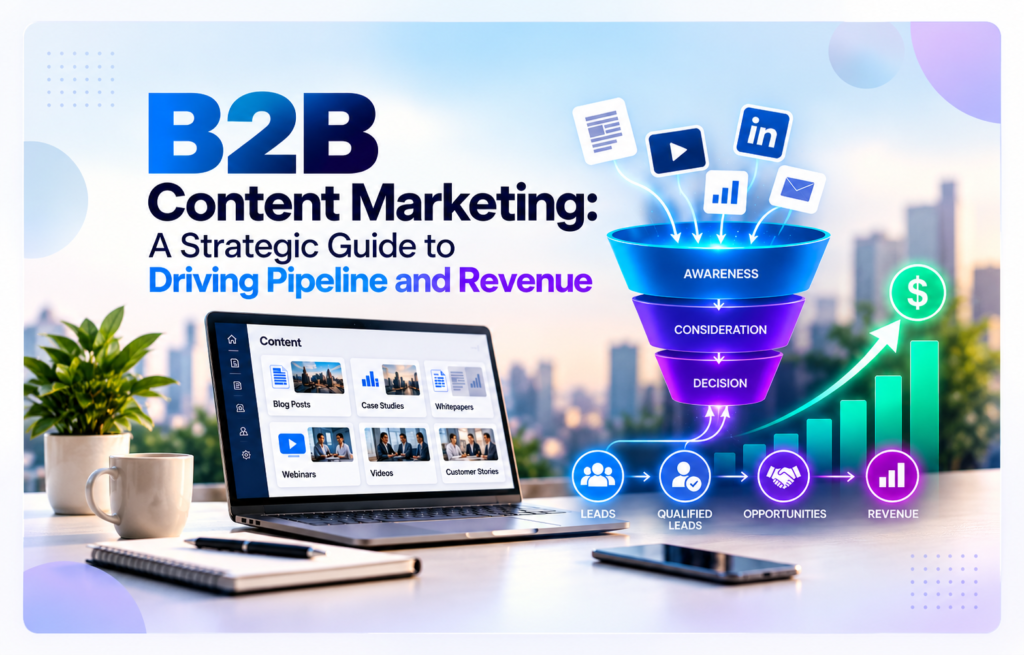
Modern buyers complete the majority of their research before speaking with a sales representative. Mapping specific content types to each phase of the journey ensures prospects find the technical and strategic guidance they need at each inflection point.
The B2B Content Lifecycle
Awareness [ Industry Reports & Guides ] │ Diagnoses pain points ▼ Consideration [ Vendor Matrices & Demos ] │Evaluates solutions ▼ Decision [ ROI Tools & Case Studies ] Validates investment
Awareness Stage
At the top of the funnel, buyers are identifying an inefficiency, a regulatory shift, or an operational vulnerability. They are not shopping for a specific platform yet; they are diagnosing a problem and sizing its financial impact.
Content at this stage must be diagnostic and problem-centric:
- Industry benchmarks and research reports showing how peer organizations allocate capital or resolve systemic bottlenecks.
- Educational guides that dissect complex technical changes or new regulatory mandates.
- Audit frameworks that help operational leaders assess performance gaps internally.
For example, an enterprise logistics firm evaluating fleet efficiency needs an analysis of the root causes behind port turnaround delays—not a sales brochure for proprietary routing software.
Consideration Stage
Once the problem is quantified, buyers evaluate alternative approaches: build versus buy, software versus managed services, or vendor A versus vendor B.
Mid-funnel content provides technical clarity and framework comparisons:
- Objective comparison matrices evaluating deployment architectures, operational models, and hidden costs.
- Technical white papers outlining the infrastructure requirements and engineering trade-offs of each approach.
- On-demand technical deep dives led by systems architects or implementation engineers detailing real-world deployments.
Decision Stage
In the final phase, the buying committee selects a specific vendor and presents a formal business case to executive leadership. The focus narrows to implementation risk, total cost of ownership, and verifiable ROI.
Bottom-funnel assets remove friction and reduce perceived risk:
- Quantified case studies outlining precise outcomes (e.g., “How Company X reduced cloud infrastructure costs by 34% in 9 months”).
- Interactive ROI calculators that incorporate the buyer’s operational inputs to model net savings and payback periods.
- Security briefs and architecture diagrams that satisfy the requirements of InfoSec and compliance teams during procurement.
Content Formats for Lead Generation
Lead generation assets must deliver immediate utility in exchange for contact details. Gating superficial overviews frustrates buyers and damages brand credibility. Reserve forms for assets that require significant capital, original research, or proprietary expertise to produce:
- Original Research and Benchmark Data: Proprietary survey data sourced from hundreds of verified enterprise practitioners.
- Diagnostic Assessment Tools: Interactive engines that generate custom maturity scores, gap analyses, or compliance audits.
- Execution Toolkits: Detailed, step-by-step implementation playbooks and engineering runbooks teams can use without hiring third-party consultants.
—
Establishing Authority Through Expert Insights
Commoditized content aggregated from basic search engine results fails to persuade senior enterprise operators. Sustainable authority requires extracting and packaging deep domain knowledge directly from internal subject matter experts (SMEs).
SME Knowledge Extraction Workflow │ ▼ [ Identify ] Engineering, Product, Solutions Teams │ ▼ [ Interview ] Extract war stories & proprietary data │ ▼ [ Transform ] Produce white papers & technical briefs │ ▼ [ Distribute] Arm sales team & run targeted ABM “`
Identify the internal practitioners closest to the actual work: solution architects, product managers, security engineers, and implementation leads. These teams understand why real-world deployments succeed or fail, but they rarely have the bandwidth to write long-form material.
Use 30-minute structured interviews to extract their domain knowledge:
- Isolate non-obvious edge cases and technical failures encountered during recent client deployments.
- Review real, anonymized production environments and discuss what they would design differently today.
- Identify industry consensus points they disagree with, and pinpoint the technical reasons behind their contrarian stance.
Content teams can then convert these transcripts into technical white papers, industry analyses, and deployment blueprints. This preserves the time of senior technical staff while ensuring your marketing reflects authentic operational depth.
Integrating Strategy with Sales Enablement
Content fails when it sits abandoned in a corporate blog archive. High-performing teams treat content as an active operational lever for direct sales enablement.
Build a Centralized Content Repository
Account executives (AEs) and business development representatives (BDRs) need immediate access to relevant assets while navigating active deals. Structure a searchable repository organized by:
- Industry vertical
- Target persona (e.g., Security, Finance, Operations)
- Deal stage (e.g., Technical Discovery, Procurement, Final Executive Review)
- Named competitors
Develop Sales-Ready Collateral
Adapt comprehensive content into sharp, deal-specific sales collateral:
- Competitive battlecards that condense long comparative guides into specific architectural advantages and counters to competitor claims.
- Modular email copy highlighting specific data points and case studies tailored for outbound sequences.
- Objection-handling briefs giving account reps structured answers to recurring concerns around migration downtime, vendor lock-in, or integration complexity.
Establish Continuous Feedback Loops
Sales teams speak directly to prospects daily; they know which claims land and which objections stall momentum. Schedule recurring bi-weekly syncs between content strategists and frontline reps. Track deal bottlenecks, recurring discovery questions, and emerging competitor positioning, then prioritize your production calendar to address those specific gaps.
Strategic Content Distribution
A high-value asset yields zero return if it fails to reach target buyers. A structured distribution plan ensures your material reaches key accounts and decision-makers directly.
Content Distribution Engine │ Account-Based Dist. Niche Media Repurposing • 1:1 InMail drops • Substack sponsorships • Data infographics • Executive social • Trade publications • Short video clips • IP-targeted display • Guest essays • Slide decks
Account-Based Marketing (ABM) via LinkedIn
LinkedIn is the primary paid and organic distribution channel for enterprise B2B. Move beyond generic company page updates to run targeted campaigns:
- Run matched-audience Sponsored Content campaigns targeting specific accounts, segmented by job title, department, and company size.
- Enable founders, technical leads, and product heads to distribute core insights directly through their personal profiles.
- Use targeted InMail campaigns to deliver proprietary research reports to target executives without an immediate sales pitch.
Niche Publications and Industry Newsletters
Mass-market media and generic business publications rarely reach specialized enterprise buyers. Identify the focused newsletters, private technical communities, podcasts, and trade associations your target buyers actually consult. Sponsoring a focused newsletter read by 4,000 verified directors will drive significantly higher pipeline value than buying broad ad impressions across an unsegmented audience of 100,000.
Repurposing Long-Form Assets
Extract maximum distribution from proprietary research and technical white papers by adapting them across multiple formats:
- Extract critical charts and statistics for standalone data graphics on social feeds.
- Condense a complex strategic framework into a five-slide operational brief for prospect presentations and pitch decks.
- Extract specific sections of a customer case study into short video interviews breaking down the implementation challenges and final financial results.
Measuring Impact Beyond Vanity Metrics
Evaluating content by page views, social impressions, or raw form fills hides whether your budget actually affects revenue. Every asset must demonstrate a clear connection to pipeline health.
Vanity Metrics vs. Pipeline Reality │ Surface Vanity │ Commercial Impact │ Organic Page Impressions │ Pipeline Velocity Change │ │ Total Resource Downloads │ Stage 2+ Opportunity Rate │ │ Post Likes / Reactions │ Closed-Won Attributed Rev
Lead Quality Over Volume
Ten downloads of an architectural blueprint by infrastructure leaders within target accounts hold far more commercial value than five hundred downloads by students, competitors, or unqualified leads. Measure the percentage of asset downloads that convert into Stage 2 Opportunities, rather than tracking top-line download volume.
Tracking Deal Velocity and Influence
Use CRM attribution data to track how content consumption impacts deal velocity:
- Do accounts that engage with technical white papers clear technical evaluations faster than unengaged accounts?
- Does circulating an ROI calculator during proposal delivery shorten procurement reviews and limit price discounting?
- Which specific case studies do account executives rely on most during discovery and proposal stages?
Attribution Modeling
Enterprise purchasing is non-linear; buyers rarely read a single white paper and request a product demo. Relying on single-touch attribution (first-touch or last-touch) misrepresents the buyer journey.
Deploy a multi-touch attribution model (such as a W-shaped model) that distributes weight across:
- The first touchpoint that introduced the brand to the target account.
- The lead creation touchpoint where a specific stakeholder exchanged credentials for a proprietary asset.
- The opportunity creation touchpoint that immediately preceded sales qualification.
Measuring content against pipeline metrics enables teams to defund formats that produce passive engagement and reallocate budget into assets that accelerate deals and secure closed-won revenue.
Frequently Asked Questions
How does B2B content marketing differ from B2C?
B2B content marketing manages protracted sales cycles involving multi-stakeholder buying groups. While B2C content often appeals to individual tastes, immediacy, and lifestyle branding, B2B assets prioritize operational risk reduction, regulatory compliance, and provable financial returns.
What are the most effective content formats for B2B lead generation?
The most reliable formats provide proprietary utility unavailable via basic search queries. These include original benchmark reports sourced from verified industry data, interactive ROI calculators that model operational cost savings, and architecture blueprints for complex enterprise deployments.
How do you measure the ROI of B2B content?
Measure content ROI by tracking its influence on qualified pipeline, win rates, and closed-won revenue using CRM multi-touch attribution. Compare sales cycle duration, average contract values, and stage-to-stage conversion rates between accounts that consumed content and those that did not.
How do you align content strategy with sales team objectives?
Establish structured collaboration, including bi-weekly interviews with account executives and solutions engineers. Pinpoint recurring objections, late-stage deal blockers, and technical concerns, then produce assets specifically designed to resolve those friction points during active sales cycles.
What is the role of thought leadership in B2B marketing?
Thought leadership reduces vendor risk during the initial research phase. Enterprise buyers choose vendors that demonstrate a clear grasp of their operational environment. Publishing authoritative perspectives on industry transformations and technical hurdles establishes institutional credibility long before the initial discovery call.